


Sanskrit language and Literature/ S. K.De./ Sanskrit Poetics as a Study of Aesthetic/ Oxford University Press/ Publication: 1963/ Number of Pages: 133/

Sanskrit Poetics as a Study of Aesthetic
Sanskrit Poetics as a Study of Aesthetics is a collection of lectures given by S.K.De at the University of Chicago. The book contains five chapters called 1. Introduction, 2. The Problem of Poetic Expression, 3. The Poetic Imagination, 4. Aesthetic Enjoyment and 5. Creation and Recreation. All these chapters deal with different aspects of classical Sanskrit aesthetic theories.
| System |
* |
|---|---|
| Publication Category |
Sanskrit Language and Literature |
| Publication Author | |
| Added Author |
* |
| Publication Language |
English |
| Publisher Name |
Oxford University Press |
| Publication Place |
Bombay |
| Publication Year |
1963 |
| Series Name |
* |
Kindly Register and Login to Darshan Manisha Digital Library. Only Registered Users Can Access the Content of Darshan Manisha Digital Library.
0
People watching this product now!
Description
Related products

Raghuvansam রঘুবংশ
Raghu Vamsa is a Bengali translation of the original epic Raghu Vamsa of Kalidasa. The translation is done in Bengali verse. The translation extends to the fifteen cantos of the original text. Nobin Chandra Das, the translator, often quotes the original Sanskrit verses in the footnote to explain his translation.

Meghduter Bhumika মেধদূতের ভূমিকা
Meghduter Bhumika is a critical assessment of the contribution of Kalidasa with special reference to Meghaduta. Parbaticharan Bhattacharya, the author of this book, offers an introduction to the literary and philosophical ideas embedded in Meghaduta. The author locates Meghaduta in the general category of the dutakavya.


Ancient Indian Erotics and Erotic Literature
Ancient Indian Erotics and Erotic Literature by Sushil Kumar De is a work on the nature of erotic literature in ancient India. The book consists of chapters: 1. Treatment of Love in Pre-Classical Literature, 2. Treatment of Love in Classical Poetry and 3. Treatment of Love in Prose Romance and Drama. The book ends with a chapter on Ancient Indian Erotics (Kama-Sastra).




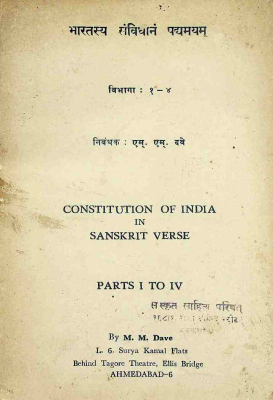
Constitution of India In Sanskrit Verse (Parts I to IV) भारतस्य संबिधानं पद्य्म्यम्
Constitution of India in Sanskrit Verse is a Sanskrit translation in verse form of parts I-IV of the Indian Constitution. M.M. Dave, the translator, argues that the Sanskrit translation of the Indian Constitution often expresses the message more clearly than in any other language. He urges the politicians, and the lawyers to use these Sanskrit translations.