


Sanskrit language and Literature/ Sir William Jones: Bicentenary of his Birth (Commemoration Volume 1746-1946)/ Royal Asiatic Society of Bengal/ Publication: 1948/ Number of Pages: 226/

Sir William Jones: Bicentenary of his Birth (Commemoration Volume 1746-1946)
Sir William Jones: Bicentenary of his Birth Commemoration Volume is a collection of essays published in the Bicentenary year of William Jones. There are nineteen essays all highlighting the contribution of William Jones. The book contains messages from all over the world extolling the contribution of Jones.
| System |
* |
|---|---|
| Publication Category |
Sanskrit Language and Literature |
| Publication Author | |
| Added Author |
* |
| Publication Language |
English |
| Publisher Name |
Royal Asiatic Society of Bengal |
| Publication Place |
Calcutta |
| Publication Year |
1948 |
| Series Name |
* |
Kindly Register and Login to Darshan Manisha Digital Library. Only Registered Users Can Access the Content of Darshan Manisha Digital Library.
0
People watching this product now!
Description
Related products


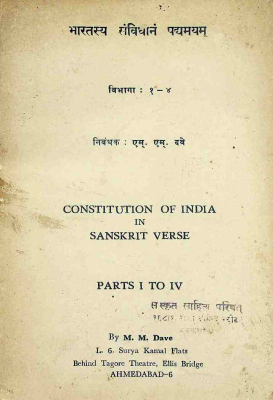
Constitution of India In Sanskrit Verse (Parts I to IV) भारतस्य संबिधानं पद्य्म्यम्
Constitution of India in Sanskrit Verse is a Sanskrit translation in verse form of parts I-IV of the Indian Constitution. M.M. Dave, the translator, argues that the Sanskrit translation of the Indian Constitution often expresses the message more clearly than in any other language. He urges the politicians, and the lawyers to use these Sanskrit translations.


Raghuvansam রঘুবংশ
Raghu Vamsa is a Bengali translation of the original epic Raghu Vamsa of Kalidasa. The translation is done in Bengali verse. The translation extends to the fifteen cantos of the original text. Nobin Chandra Das, the translator, often quotes the original Sanskrit verses in the footnote to explain his translation.