Showing 31–60 of 77 results

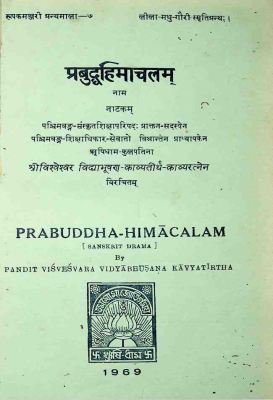
Prabuddha-Himācalam प्रबुद्ध हिमाचलम

Prabuddhahimacalam is a drama authored by Viśveśvara Vidyābhūṣaṇa. The drama was written against the background of the Indo-China war in the early nineteen sixties. The drama depicts how Indians could rise and thwart foreign aggression.

Pratijñāyaugandharāyaṇam प्रतिज्ञायॊगन्धरायण्म

Pratijñāyaugandharāyaṇam is an edition of the original Sanskrit drama thought to be written by Bhāsa. C.R.Devadhara edited this book with an English translation and explanatory notes.

Priyadarsika प्रियदर्शिका

Priyadarsika is an English rendering along with explanatory notes of the drama originally written by Sri Harsha. P.V.Ramanujaswami, the editor and translator of the book gives a brief history of classical Indian Dramaturgy in the introduction followed by the original text and explanatory notes.

Puruṣaramaṇiyam पुरुषरमणीयम्

Puruṣaramaṇiyam is a short comedy written by Srijiva Nyāyatīrtha written on the occasion of the visit of Srimat Chandrasekharendra Sarasvati to Calcutta. On one occasion, one of the male characters was transformed into a lady and that is how the title justifies itself.

Raghuvansam (Canto-VI) सारस्बत – शतकम

Raghuvansam is a Bengali translation of, along with explanatory notes in English on, the sixth canto of Raghuvansam written by Kalidasa. Mallinatha’s commentary on the relevant part has also been added by Haricharan Gangopadhyay and Ramgopala Bhattacharya who are the editors of the present volume.

Rupaka-Chakram रूपक-चक्रम

Rupaka-Chakram is a collection of five small dramas known as prahaṣaṇa. The collection consists of 1. Mahakavi kalidasam, 2. Ragaviragam, 3. Ksutaksemiyam, 4. Cipitakacarvanam and 5. Satavarsikam. All the dramas are written by Srijiva Nyāyatīrtha.

Śabdakalpadrum (Volume-1) শব্দকল্পদ্রুম

Sabdakalpadruma (first volume) is a dictionary of Sanskrit words compiled by Raja Radhakanta Dev Bahadur. It contains the meaning of all the Sanskrit words, their etymological analysis and examples of their use. The dictionary is organized in alphabetical order. The first volume contains starts with varna and ends with ‘plama’.

Śabdakalpadrum (Volume-2) শব্দকল্পদ্রুম

Sabdakalpadruma (second volume) is a dictionary of Sanskrit words compiled by Raja Radhakanta Dev Bahadur. It contains the meaning of all the Sanskrit words, their etymological analysis and examples of their use. The dictionary is organized in alphabetical order. The second volume starts with ‘plaksadva’ and ends with s.

Śabdakalpadrum (Volume-3)

Sabdakalpadruma (third volume) is a dictionary of Sanskrit words compiled by Raja Radhakanta Dev Bahadur. It contains the meaning of all the Sanskrit words, their etymological analysis and examples of their use. The dictionary is organized in alphabetical order.

Sāhitya Darpana साहित्यदर्पन्

Sahityadarpana is a classic Sanskrit work on aesthetics. This book, originally written by Viśvanātha Kavirāja, contains a commentary by Rāmcharana Tarkavāgīśa Bhattacharya.

Samskrita Ravindram संस्कृत रबीन्दम्

Samskrita Ravindram is a collection of Sanskrit renderings of excerpts from Rabindranath Tagore’s poem, drama and essay. The collection is edited by V. Raghavan and the foreword is written by S. Radhakrishnan.

Śāṅkhāyana-Brāhmaṇaṃ शाङ्खायन् ब्राह्मणम्

Śāṅkhāyana-Brāhmaṇaṃ is a Bengali translation and explanation of the original Sanskrit text Śāṅkhāyana-Brāhmaṇaṃ. The translation describes the different kinds of rituals as prescribed in the Vedic literature. The translation is done by Harinarayan Bhattacharya.

Sāraswata-Śatakam (Citra-Kavyam) सारस्बत – शतकम

Saraswatakam is a chitrakāvya written by Srijiva Nyāyātirtha. The genre of Chitrakāvya is a unique example of the marriage of literature and picture. In this work, the letters are written and the consequent verses are composed in such a manner, that a specific picture arises in the mind of the reader. The author composed the verses expressing different emotions and gave corresponding drawings containing the alphabet that the verses contain.

Smṛti Sandarbhaḥ (Volume-2) स्मृति सन्दर्भ: (द्बितीय भाग)

Smṛti Sandarbhaḥ (editor’s name not mentioned) is a collection of Smṛti texts including Parasara Smṛti etc.

Smṛti Sandarbhaḥ (Volume-3) स्मृति सन्दर्भ: ( तृतीय भाग)

Smṛti Sandarbhaḥ (part III) is a collection of some important parts of different Smṛtiśāstras. The salient parts from different Smṛtiśāstras like Yajnyavalkyasmrti, Katyanasmrti, Apastambasmrti, Likhitasnrti Ausanasasamhita etc. have been collected in this book.

Smṛti Sandarbhaḥ (Volume-4) स्मृति सन्दर्भ: (चतुर्थो भाग)

Smṛtisandharvaḥ (part IV) is a collection of some important parts of different Smṛtiśāstras. The book focuses on three major issues viz. manner (ācāra), social law (vyāvahāra) and repentance (tapasyā). Excerpts from the important Smṛtiśāstras in their original Sanskrit, like Gautamasmrti, Yamasmrti, Arunasmrti, Pulastyasmrti, Vasisthasmrti etc. dealing with these three topics have been published in this book.

Smṛticintāmaṇiḥ স্মৃতিচিন্তামনি:

Smrticintamanih is a work on Smrti describing the rituals prescribed by different Smrtisastras on different occasions in human life. The book is written by Haridas Siddhantavagisa.

Suryaprabha kimba Vaibhava Pisacah सुर्य्यप्रभा किंबा बैभब् पिशाच्:

Suryaprabha or Vaibhavapisacah is a story written by Srinivas Śāstri in Sanskrit. The main storyline of the book is how different mundane pleasures like wealth, house, gold etc, mislead the human in the attainment of his ultimate goal, viz. spiritual emancipation.

Swapnavasavadattam

Svapnavasavadattam is an English rendering of the drama Svapnavasavadattam written by Bhasa. Saradaranjan Ray has added his own Sanskrit commentary along with a Bengali translation of the original text. In the introduction, the translator offers an analysis of the features of the literary contribution of Bhasa.

Tarkakaumudī

The present book (edited and translated by K.N.Chatterjee) is an exposition of the text called Tarkakaumudī, written by Laugākṣibhāskara. This book presents the main ideas advocated by the Nyāya-Vaiśeṣika school of philosophy, viz. the different prameyas and the different pramāṇas.

Tattvamīmāṃsādarśnam तत्त्वमिमांसादर्सनम्

In this book, the author Girindranatah Vedantaratna presents his views on different aspects of classical Indian Metaphysics. The book has sixteen chapters. The author discusses several issues like the nature of the world, the nature of the individual self, the nature Adhikāri, the nature of upāsanā and the nature of liberation.

The Brahmasūtra – Śāṅkarabhāṣya: Bhāmatī (Volume-1) ব্রহ্মসূত্র – শাঙ্করভাষ্য ভামতী (১ম খন্ড)

This book is a detailed Bengali translation and explanation of the Bhāmatī commentary on Saṅkarāchārya’s commentary, written by Srimohan Bhattacharya. Vācaspati Miśra is the author of Bhāmatī commentary. During the course of the explanation, Srimohan Bhattacharya highlights the views held by the author of Bhāmatī as different from another commentarial tradition  of Advaita Vedānta, viz. the Vivaraṇa school. The Bhāmatī commentator defends his interpretation of some of the fundamental concepts of Advaita Vedānta viz. the nature of the discourse on Brāhman, the nature of svādhyāya, refutation of Śabdaparikṣāvāda, the nature of the individual jīva, the locus of ajñāna, etc. This is a fine example of intra-school philosophical debate that could be found in many other classical Indian philosophical systems.

The Brhama Puraṇam (Volume-2) ब्रह्मपुराणम् (द्बितीय भाग)

Brahmapurāṇam contains the entire text of Brahmapurāṇa in the original Sanskrit language. Of all the Puranas, Brahmapurāṇa is one of the most important ones.

The Constitution of India

This book entitled Mulam Sanskritam, (author unknown) presents the role and significance of Sanskrit in the Indian education system.

The Padārthatattva-Nirūpaṇam (পদার্থতত্বনিরুপনম)

The present book, written by Raghunātha Śiramaṇi and translated and explained in Bengali by Madhusudan Bhattacharya,  is an attempt to present his views on the metaphysical categories generally accepted in the Nyāya-Vaiśeṣika tradition. Raghunātha, of course, refutes some of the categories accepted by earlier Nyāya-Vaiśeṣika philosophy. He even does not hesitate to accept some of the views of the Mīmāṁsā philosophy, thereby going against his own tradition.

The Rasaganngādhara रसगङ्गाधर:

Rasagangadhara is working on Sanskrit aesthetics written by Jagannātha paṇḍit. This book also contains the commentaries of Nagesabhatta and Mathuranatha Shastri.

The Vyakti-Viveka (Part-1) व्यक्ति-विवेक:

This book, written by Mahima Bhaṭṭa, has been explained in Bengali by Bishnupada Bhattacharya. In this book, the author criticizes the Dhvani theory propounded by Ānandavardhan. Mahima Bhaṭṭa, like fellow Kashmir thinkers, was influenced by the philosophy of Pratyabhijñā. Mahima Bhaṭṭa was also well acquainted with the works of Diṅnāga and Dharmakīrti. The central contention of Mahima Bhaṭṭa, which has been explained in this book, is that Dhvani theory and vyāñjanā relation could be included in inferential knowledge. Mahima Bhaṭṭa argues that words have only the power of meaning and nothing else is required to account for the denotative power.

Uttarakurukṣetram उत्तरकुरुक्षेत्रम्

Uttarakurukṣetram is a drama written by Viśveśvara Vidyābhūṣaṇa based on the events in Mahābharata. The author laments over the degeneration in the social life of post-independent India and recreates the events that followed the war of Kurukṣetra.

Vālmīki – Samvardhanam वाल्मीकि-संवर्द्धनम

Vālmīki-Samvardhanam is a drama written by Viśveśvara Vidyābhūṣaṇa. The main storyline centres around how Ratnakar, the thief, turned into the sage Vālmīki.

Vedānta-Darśanam (Volume-1) বেদান্ত দর্শনম (১ম খন্ড)

The author of this book, Kalivar Vedantavagisa, presents a detail exposition of Saṅkarācarya’s commentary on Vedānta-Sutra along with a presentation of the views of the author of the commentary called ’Bhāmati’. This book extends to the four chapters of the Vedānta-Sutra. Durgacaran Sāṁkhya-Vedānta-tirtha adds his own understanding of the different interpretations of various sutras.