

Publications


Classical Indian Philosophies: Their Synthesis in The Philosophy of Sri Ramakrishna
In this book, Satischandra Chatterjee, presents the salient views of different classical Indian philosophical systems and shows how these divergent views could be synthesized in the philosophy of Ramakrishna. The book contains ten chapters: 1. Introduction, 2. The Cārvāka Philosophy, 3. The Bauddha Philosophy, 4. The Jaina Philosophy, 5. The Nyāya-Vaiśeṣika Philosophy, 6. The Sāṃkhya-Yoga Philosophy, 7. The Mīmāṃsā Philosophy, 8. The Vedānta Philosophy, 9. The Synthesis of the Systems and 10. The Philosophy of Ramakrishna. The author argues how on the basis of the idea of adhikāri-veda the divergent views of the different philosophical systems could be synthesised and the author takes cues from the ideas advocated by Sri Ramakrishna in this attempt.

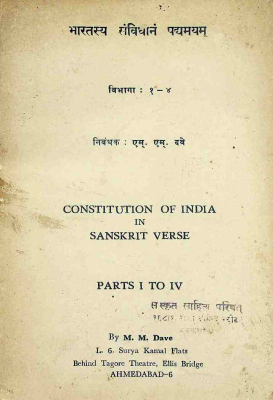
Constitution of India In Sanskrit Verse (Parts I to IV) भारतस्य संबिधानं पद्य्म्यम्
Constitution of India in Sanskrit Verse is a Sanskrit translation in verse form of parts I-IV of the Indian Constitution. M.M. Dave, the translator, argues that the Sanskrit translation of the Indian Constitution often expresses the message more clearly than in any other language. He urges the politicians, and the lawyers to use these Sanskrit translations.


Cultural Otherness and Beyond
Cultural Otherness and Beyond is a collection of essays on philosophy of culture. This volume is edited by Chhanda Gupta and D.P.Chattopadhyaya. There are eleven essays in this volume, all dealing with the very idea of culture and nature of understanding a culture. This brings in the idea of exchange among different cultures where the concept of other plays an important role.


Facts of Buddhist Thought
The present book comprises three chapters: 1. Pratītyasamutpāda in Buddhist philosophy, 2. The Mādhyamika and the philosophy of language and 3. Idealism and Absolutism - A Buddhist synthesis. In the first chapter A.K.Chatterjee, the author, traces the theory of pratītyasamutpāda from the Abhidharmika stage through Mādhyamika and Yogācāra interpretations. In the second chapter, the author defends the Mādhyamika position in terms of metalanguage and object-language distinction. The third chapter takes up the issue of Yogācāra idealism in terms of sahopalambha-niyama and shows how idealism culminates in Absolutism.

Fundamental Questions of Indian Metaphysics and Logic
Susil Kumar Maitra, in this book, offers an analysis of some of the key metaphysical and logical ideas available in classical Indian philosophy. The book is divided into two parts: I. Metaphysics and II. Logic. Under the part ‘Metaphysics’ the author discusses the Buddhist doctrine of momentariness, Nyāya theories of causality, universal, samavāya, viśeṣa, self etc. The Nyāya proofs for the existence of god and the Sāṃkhya theory of plurality of puruṣa have also been presented. The author incorporates an analysis of Jaina’s theory of saptabhaṅginaya and Saṅkarācārya’s analysis of the idea of falsity. Under the Logic part, the author presents the different theories of perception, inference, śabda, upamāna, arthāpatti and anupalabdhi. The author also includes discussions on Apoha and theories of validity.

Gadādhara’s Theory of Objectivity Viṣayatāvāda (Part-One)
In this volume, Sibajiban Bhattacharyya presents an analysis of the fundamental concepts in Navya-Nyāya. The themes that have been discussed in this book are 1. Navya-Nyāya theory of Relation, Being in Aristotle and Navya-Nyāya, Navya-Nyāya theory of universals, Navya-Nyāya theory of abstraction, Navya-Nyāya theory of definition, Navya-Nyāya theory of causation, Comparative analysis of Frege and Gadādhara.

Gadādhara’s Theory of Objectivity Viṣayatāvāda (Part-Two)
In this book, Sibajiban Bhattacharyya offers a detailed analysis of the text called Viṣayatāvāda, written by Gadādhara. After explaining the traditional Navya-Nyāya theory of objectivity, the author presents the later Navya-Nyāya theory of objecthood where it has been argued that objecthood cannot be cognition itself. Gadādhara’s theory of relation has been analyzed in terms of objecthood of qualified cognition. A detailed analysis of the ideas of qualificandness, qualificandumness, predicatehood could be found in this book.


Gaṅgeśa’s Theory of Indeterminate Perception (Nirvikalpakavāda) Part- 1
In the part one of this book, Sibajiban Bhattacharyya, presents an introductory analysis of Navya-Nyāya philosophy. The book is divided into five chapters: 1. The Navya-Nyāya Theory of Cognition, 2. Some basic Concepts of Navya-Nyāya, 3. Navya-Nyāya Theory of Inference, 4. Some Terms of the Technical Language of Navya-Nyāya and 5. Some Aspects of Navya-Nyāya Theory of Language.

Gaṅgeśa’s Theory of Indeterminate Perception (Nirvikalpakavāda) Part- 2
The present book is an English translation and explanation of the chapter on Nirvikalpakavāda in Tattacintāmaṇi by Gaṅgeṣa. Each of the parts of the original text has been followed by an explanation. Many objections to Gaṅgeṣa’s theory of indeterminate perception have been explained and responded to by the author.


Gopinath Kaviraj’s Thoughts – Towards a Systematic Study
This book by Kalidas Bhattacharyya is a collection of Mahamahopadhyay Gopinath Kaviraj Memorial lectures delivered by Kalidas Bhattacharyya in the year 1980. Bhattacharya here explores the works of Gopinath Kaviraj written in the later years of his life. Kaviraj was an extraordinary scholar who was well-versed in both the philosophical and religious literature of India as well as the west. Above all, he was a sādhana. He was principally a Śaiva, particularly of the monistic kind, However, as Bhattacharyya claims, this Śaiva doctrine received certain innovative twists in the hands of Kaviraj and became a kind of Śaiva Dualism. Kaviraj was equally interested in Tantra, Yoga, Mahāyāna Buddhism, Gauḍiya Vaiṣnavism and also Śankara’s Advaita Vedānta. In this book, Kalidas Bhattacharyya explores the notion of Transcendence and the justification of this notion that we find in the works of Gopinath Kaviraj. He discusses the different regions of Transcendence and finally goes on to discuss the idea of Pūrṇatā or Ultimate Perfection as developed by Kaviraj.


Heteroclitic Fragments and Heretical Comments
This book is a collection of six essays written by A.P.Rao. All the essays offer the author’s own views on some of the issues that have been dealt with in recent Logic and Metaphysics. The book starts with an essay on Leibnitz. The author articulates his own understanding of some of the logical problems attended to by Russell and Wittgenstein. Also, there are discussions on views on ontology expressed by Quine.


Hindu Ṣaḍa Darśan হিন্দু ষড়দর্শন
This book, written by Swami Pratyagātmananda Saraswatī, is an introduction to the major philosophical systems of classical India. In the Introduction, the author offers a conceptual introduction to the nature of Indian philosophy. In the second chapter, the author offers an analysis of the eligibility conditions of the different schools of Indian philosophy. The author devotes separate chapters on Saṇkhya-Yoga, Nyāya-Vaiśeṣika and Mīmāṃsā philosophies.

History of Navya Nyāya in Mithilā
The present book is a detailed history of Navya-Nyāya scholarship in Mithilā, located in the state of Bihar, India. Of the two main centres of Navya-Nyāya, Mithilā is well-known for being the birthplace of Gaṅgeśa, the originator of Navya-Nyāya. The book has six chapters: 1. Udayanācarya: his predecessors and successors, 2. Pre-Gaṅgeśa writers, 3. Gaṅgeśa Upādhyaya and his son Vardhamāna, 4. The age of expansion, 5. The age of four M’s and 6. Modern scholarship. The author presents brief life-sketches and brief descriptions of the works of these philosophers.

History of Sanskrit Poetics
History of Sanskrit Poetics is a detailed historical survey of Sanskrit literary theory. Sushil Kumar Dey, the author of the book, divides the work into two volumes. The first volume contains ten chapters starting with Bharata and ending with a discussion of some minor writers of Alankara. The second volume contains ten chapters starting with Bhamaha and ending with a discussion of the writers of Kavi-śikṣā.

History of Sanskrit Poetics (by P. V. Kane)
History of Sanskrit Poetics by P.V.Kane is a historical survey of Sanskrit Poetics. The book is divided into two parts. The first part consists of thirty-nine chapters where the author presents the main contents of the major world in Sanskrit Poetics. The second part contains sixteen chapters where one finds a brief survey of the main theories in this field showing how these different literary theories evolved in the course of history.

History, Society and Polity
In History, Society and Polity, D.P.Chattopadhyaya undertakes a detailed study of the sociological ideas of Sri Aurobindo. The book is divided into eleven chapters. In all these chapters the author presents Sri Aurobindo’s insights on society, state and individual and the nature of their interaction. A comparative study of Marx and Aurobindo has been embarked on by the author in this book.